Therapy changes when the body stops being a battlefield and becomes an ally. Many clients arrive knowing the story of what happened yet feeling overrun by symptoms they can’t negotiate: heart racing at stoplights, an iron band around the chest, hands that go numb during conflict, a sudden floaty feeling before a hard conversation. Befriending the body is not about dredging up more pain. It is about finding reliable ways to notice, pace, and include bodily experience so the nervous system learns safety from the inside out.
Somatic skills are not a niche add-on to trauma therapy. They are the practical language of state change, the levers we can move when words are too blunt. Used with care, they stabilize trauma processing, make EMDR therapy safer, soften rigid patterns in couples therapy, help children translate sensation into play, and offer neurodivergent clients options that respect sensory realities. These skills are deceptively small. Over time, they recalibrate how a person approaches fear, closeness, and choice.
What the body remembers, and how it lets go
Trauma imprints in the nervous system as patterns of protection. The body is doing its job when it goes into fight, flight, freeze, or collapse. After a single incident like a car crash, the response can stick, showing up as startle, tension, or avoidance at the faintest cue. With developmental or chronic trauma, the nervous system may lean toward shutdown or hypervigilance most of the time. This is not a moral failing. It is physiology and learning.
The brain does not distinguish sharply between body and mind. Interoception, the sense of internal signals, underpins emotion. If you do not feel your heartbeat and breath, you often do not know what you feel emotionally either. Conversely, if sensation is overwhelming, naming emotion can feel like throwing a label on floodwater. Befriending the body asks for a middle path: enough contact to feel, enough structure to not drown.
Therapists often teach the window of tolerance as a map. Inside is the range where a person can think, feel, and choose. Outside is hyperarousal, where survival reflexes dominate, or hypoarousal, where energy drops, numbness spreads, and words drift away. Good somatic work flexes this window gradually. It is not a macho stretch. It is titration, a chemistry term for small, measured additions that avoid a reaction boiling over.
Polyvagal theory gives language to how connection and safety shift state. When the ventral vagal system is online, we get curiosity, connection, and facial softness. In trauma, the dorsal vagal brakes can clamp hard, sending a person into shut-down. Somatic skills help invite ventral tone: eye contact that feels kind, exhale that lengthens slightly, posture that supports the head without strain. None of this is mystical. It is mechanical and relational.
Safety and consent are the frame
Somatic work is intimate. Asking someone to close their eyes, feel their belly, or notice their pelvic floor is not neutral. Cultural, religious, and personal boundaries matter. Trauma often includes experiences where bodily autonomy was taken. The antidote is choice and clarity at every step.
Use the following checklist as a baseline for safety:
- Offer a menu, not a mandate. Clients can opt out of any exercise or change it to fit their body. Explain the why before the how. A brief rationale reduces fear of the unknown. Use external orientation first. Looking around the room and naming neutral objects anchors the present. Keep contact cooperative. If touch is used, obtain explicit consent each time and name where, how, and for how long. Plan exits. Establish a signal to pause or stop, and a simple way to re-ground if emotions surge.
Medical conditions matter too. Untreated cardiac issues, severe respiratory illness, epilepsy, post-concussive symptoms, pregnancy, and chronic pain can change what is safe. For example, breath holds are not appropriate for clients with a history of fainting, and strong twists may aggravate spinal conditions. When in doubt, consult with medical providers and adapt.
Core practices that build capacity
Somatic skills are easiest to learn when they are concrete and brief. Five minutes of skilled practice often beats forty minutes of vague scanning. Below are practices I use weekly in trauma therapy, adapted to fit various bodies and histories.
Orienting: let the eyes lead the nervous system
Ask the client to gently look around the room and let their head follow. Describe three neutral or pleasant objects. Name colors, shapes, and distances. This seems trivial. It is not. In fear states, vision narrows and locks on threat. Tracking the environment at a relaxed pace recruits safety pathways. In couples therapy, I sometimes use joint orienting: both partners turn and name items together. The room shifts from courtroom to landscape, which changes how arguments unfold.
Grounding through contact, not force
Grounding is often taught as pushing feet into the floor. That can help, but force is not the point. Try contact instead. Place attention on where the body meets support: sit bones on the chair, calves against the cushion, tongue resting on the palate. Ask what feels most supportive. Let the client fine-tune the setup, then linger a few breaths. This is valuable with neurodivergent therapy, where proprioceptive input is regulating for many people. A weighted lap pad, a firm arm of a chair, or a fidget object can serve the same function.
Breath as brake and as bridge
Breath practices are everywhere, and not all are helpful for trauma. For some clients, focusing on breath triggers panic or memories. Use breath as a mechanical lever. The exhale connects to the vagal brake. A small change, like a slightly longer exhale than inhale, can cue calm without triggering alarms. One accessible ratio is inhale for three counts, exhale for four or five. For clients who dislike counting, use imagery: smell something warm through the nose, sigh it out through pursed lips. When panic is high, cue breath low in the ribs rather than chest, and pair it with looking at a stable object.
Micro-movements to release stuck energy
People often think movement must be big to count. In trauma therapy, small is safer and often more effective. Invite shoulder rolls the size of a coin, pelvic tilts like moving a joystick, ankle circles half an inch wide. Add choice: faster, slower, or still. After a freeze response in EMDR therapy, micro-shaking the hands can discharge some activation without re-enacting the event. Clients with chronic pain often tolerate micro-movements better than stretches. This builds confidence that movement does not equal threat.
Temperature and texture as state shifters
A cool compress on the face, a warm mug in the hands, or a textured ball under the palm can move state quickly. The trigeminal nerve at the face responds strongly to temperature. I keep a soft washcloth, a rubber dog toy, and a couple of smooth stones in the office. These are especially helpful with teens in child therapy who roll their eyes at breath work but will accept a dare to hold an ice cube for ten seconds.
Sound and voice to vibrate safety
Hum on an exhale. Use a gentle “voo” or “mmm” through closed lips. The vibration against the chest and face seems to recruit ventral tone for many clients. Singing along to a familiar song can be more tolerable than sitting in silence. In couples sessions, a synchronized 10 second hum creates a shared rhythm that often softens facial tension. For neurodivergent clients who find humming overstimulating, low-volume instrumental sound can be a bridge.
Contact with emotion in small doses
Somatic work is not just regulation. It is also the ability to feel difficult things without getting swept away. Pendulation is a simple form: touch a safe or neutral sensation for a moment, then touch a difficult sensation, then return to safe. For example, rest attention on the weight of the thighs on the chair, then notice the tightness under the ribs, then go back to thighs. Two or three swings at a time is plenty. Over weeks, the difficult spot often becomes less sticky.
A short arrival practice you can learn in session
Clients remember practices that feel doable and precise. I teach a five minute arrival we can repeat at the start of sessions and during the week. It moves through orientation, breath, and contact.
- Look around at three objects, name color and shape quietly to yourself. Feel where your body is supported by the chair, adjust to increase comfort by ten percent. Inhale gently through the nose for three counts, exhale through pursed lips for five, repeat for six breaths. Place one hand on the side of your ribs, notice movement under your hand for three breaths, then remove your hand. Find one sensation that is neutral or pleasant, rest attention there for twenty seconds, then open your eyes wider and take in the room.
Small numbers help. If the client requests a recording, I’ll record it live on their phone. Over three to four weeks, I watch whether they can enter the room and drop into this routine faster. That change is a concrete measure of increased capacity.
Making EMDR therapy safer with somatic anchors
EMDR therapy is powerful because it uses the nervous system’s own updating mechanisms. Bilateral stimulation through eye movements, taps, or tones helps the brain integrate stuck memories. When the body takes over during reprocessing, however, a session can derail. Somatic skills give us anchors and levers.
Before reprocessing, install somatic resources alongside the standard calm place or nurturing figure. Not everyone has a visual safe place. A resource can be a felt sense of warmth behind the sternum or the feeling of the floor under the heels. I might ask the client to locate a body-based sense of okay, exaggerate it by five percent, and pair it with slow bilateral tapping. During reprocessing, I track breath, jaw tension, and shoulder position as closely as I track words and images. If breath arrests or the jaw locks, I pause the set and help the client complete a small exhale or soften the molars. That often allows us to continue without losing momentum.
SUDs ratings can include somatic markers. A client might say, “SUDs is an 8 and my hands are tingling at a 6 out of 10.” During sets, I ask brief body check-ins: “What do you notice now, in your body?” If a client drifts toward dorsal shutdown, I use orientation, a louder voice, and sometimes a standing break to bring ventral energy back online. With clients who dissociate, I keep one foot anchored in the room, literally. We agree they will keep at least one foot in contact with the floor at all times. These small contracts make a difference.
Couples therapy: co-regulation before content
Couples walk in with stories about fairness and blame. Their bodies tell another story: one partner’s shoulders up by their ears, the other slumped with eyes averted. Before tackling content, I often work on co-regulation. Two nervous systems that can coordinate have a better chance of understanding each other.
A simple exercise: sit at an angle, not directly face to face. Both partners orient to the room together, then choose a shared external focus like a plant or a window. Breathe at your own pace for two minutes while holding a loose hand contact, then release. I watch for color return to the face, sighs, and eye softening. After that, conflict work changes. A hand squeeze can signal “I need a pause” without raising voices. When apologies get stuck, I cue both to notice the https://beaunmub888.huicopper.com/child-therapy-for-trauma-building-resilience-through-play sensation of regret in the body and name it plainly. This lands more deeply than rehearsed statements.
Partners with trauma often trigger each other’s survival patterns. A raised voice can feel like a past abuser. Silence can feel like stonewalling even when it is shutdown. Teaching state language helps. If a partner can say, “I’m dropping into low energy, I need to stand and look out the window for one minute,” the other partner learns to recognize shut-down without taking it personally. Over months, fights shorten, repairs come quicker, and affection returns.
Child therapy: play, posture, and concrete tools
Children live in their bodies. They also borrow regulation from adults. Somatic work with kids looks like games, not lectures. I might make a “superhero stance” contest, where we try on wide stance, hands on hips, chin level, and notice what feelings come with it. Then we switch to a “turtle shell” with shoulders in and eyes down. We talk about when each stance helps. For nightmares, I teach a “teddy bear breath,” belly breathing with a small plush rising and falling. A child who struggles to name feelings can name where the feelings live. A kitchen timer and a squishy ball can transform a meltdown into a two minute squeeze session.
Trauma in kids often shows as stomachaches, school refusal, or explosive behavior. The goal is to make sensation less scary and give them exits. Parents are part of the system. I coach caregivers to model soft eyes, slowed speech, and longer exhales when their child escalates. In family sessions, I sometimes set up a “body signals map” with color stickers for hot, cold, heavy, and buzzy. Over six to eight sessions, kids begin to predict and intercept their own surges, which is the foundation of self-control.
Neurodivergent therapy: respect sensory realities and monotropism
Autistic and ADHD clients often have interoceptive differences. Some do not feel hunger until it is extreme. Others find internal focus aversive. Demanding breath focus for three minutes can backfire. Start where regulation already happens. Stimming is regulation. Rocking, flapping, pacing, and fidgeting are not problems to extinguish. They are levers we can shape.
I ask detailed questions about sensory profiles. Is deep pressure soothing or irritating today, not just in general? Are fluorescent lights a problem? Can we swap a chair? For some autistic clients, eye contact is dysregulating, so I seat us side by side or on a walk. For ADHD clients, I build movement into the session: stand for part of it, use a balance cushion, or switch tasks every eight to ten minutes. Monotropism, the tendency to focus deeply on one interest, is an asset. If a client loves trains, we use train imagery for breath and movement. Progress looks like more control over attention shifts and less post-episode shame.
Language also matters. Many neurodivergent clients find metaphor slippery or invalidating. I keep instructions literal and short. Instead of “sink into your body,” I’ll say, “Notice the feeling of your socks on your toes for ten seconds.” We celebrate genuine choice. If a client declines a practice, that is success in autonomy.
Working with dissociation: double awareness and gentle pacing
Dissociation keeps people alive during the unbearable. It does not negotiate easily. Therapists often push too fast. My rule: stay where the light is. If a client frequently loses time or feels unreal, we build double awareness. One foot in the traumatic material, one foot in the room. We keep eyes open more. We use tactile anchors like a textured coaster, a cool drink, or tapping on the thighs while speaking. Parts language can help, but I do not force it. If a client experiences distinct parts, we collaborate with them respectfully. If not, we still work with state shifts.
I avoid long body scans with dissociation. Ten seconds at a time is safer. I keep my voice more animated and slightly louder to counter dorsal descent. If we touch a freeze, we complete a small physical pattern: push the hands against the knees for two seconds, release, repeat twice. This completes something that felt incomplete, which often frees words that were locked behind the freeze. Over many sessions, the client learns they can feel a bit more and return, which is the heart of trauma resolution.
Myths, limits, and ethics
Somatic therapy does not move toxins or unlock repressed memories by itself. It is not a cure-all. Some pain is structural, not psychogenic. Some panic stems from thyroid or cardiac issues. Some trauma symptoms lessen significantly, others become more manageable rather than disappearing. I track for false positives. If a client’s panic appears with caffeine or upon standing, I consider POTS and refer to a physician. If pelvic trauma is present, I avoid internal practices and collaborate with a pelvic floor physical therapist.
Touch is not required. Many therapists never use it. If you do, get training, have explicit policies, and keep touch minimal and client-led. Cultural humility is needed. In some cultures, closing eyes in front of strangers or reclining on a couch is unthinkable. Ask instead of assuming. The goal is not to import a Western somatic ritual, but to build embodied agency within the client’s context.
Measuring progress without reducing humans to checkboxes
Data helps, but not at the expense of nuance. I use a blend of subjective and behavioral markers.
- SUDs and VOC in EMDR sessions, noting somatic anchors alongside numbers. Brief weekly ratings of sleep quality and startle intensity on a 0 to 10 scale. A two minute arrival time: how long from walking in to feeling settled at a 6 out of 10 or better. Frequency of shutdowns or panic episodes over a 30 day window. Specific behavioral goals, like driving through the intersection where the crash happened or initiating a hard conversation with a partner.
Numbers guide us, they do not define us. I also ask qualitative questions: What surprised you about your body this week? Where did you say no faster? What felt ten percent easier?
A brief vignette: what change can look like
M. Was a 37 year old nurse who developed panic driving after a rear-end collision. She gripped the wheel until her wrists ached, avoided highways, and felt shame about her fear. We worked for twelve sessions over four months. The first two focused on building somatic anchors: orienting, exhale lengthening, and a sense of weight in her thighs. In session three we practiced micro-movements of her shoulders while recalling neutral scenes. She learned she could let the shoulders round and then release, which became a cue for softening.
In session five we began EMDR therapy on the moment of impact. During the first set, her breath caught and her hands went cold. We paused, looked around the room, and she squeezed a rubber ball while exhaling for five counts. On the next set, the image shifted from the brake lights to the sound of crunching metal. SUDs dropped from 9 to 5. By session seven, we processed the fear at the on-ramp. She practiced the five minute arrival in her parked car every morning for two weeks. In week ten, she drove two exits on the highway with a friend. By session twelve, she could drive alone during daylight. Panic would still nibble at the edges, but it did not swallow her. The most meaningful change to her was not the driving. It was noticing she could feel her heart rate rise and think, I know what to do, then do it.
Integrating somatic skills into daily life
Therapy is a small slice of time. The body learns through repetition in context. I prefer “micro-practices” that fit into ordinary routines. While brushing teeth, stand with feet hip-width and feel the weight shift from heel to ball for thirty seconds. At red lights, soften the jaw and lengthen one exhale. Before opening a difficult email, look at three far corners of the room. In couples, create a ritual where both partners spend ninety seconds arriving before discussing logistics. For parents, turn transition times into body time: hum while putting on shoes, squeeze a stress ball during homework checks.
If a practice creates distress, we change it. If a client never does a practice, I look for friction points: too long, too vague, too boring. Sometimes the best practice is swapping a harsh chair for one with real lumbar support. Not everything has to be deep.
When the body is a loud place: chronic pain and eating disorders
Chronic pain scrambles interoception. For someone with fibromyalgia, scanning the body can feel like walking into a thunderstorm. The aim shifts to finding islands of relative ease and expanding them. That might be the earlobe, the breath at the nostrils, or the feeling of the back against a pillow. Movement is graded and tiny. Pain neuroscience education helps, but not if it becomes a debate. We respect the pain, then look for small freedoms.
Eating disorders complicate somatic work by turning sensation into threat and control. Fullness cues can trigger panic, and body-focused practices can be hijacked by the disorder. I coordinate with dietitians and medical providers. Practices are external and brief: orienting, temperature shifts, hand on a chair rather than on the abdomen. Language is careful. We focus on function, not appearance. Over time, if and when the client is ready, deeper interoceptive work can emerge within a solid containment plan.
The therapist’s body is part of the intervention
Clients borrow our nervous systems. If I barrel into session with tight shoulders and shallow breath, no technique will mask that. I do the same arrival practice before I open the door. I keep water and a soft object in my own reach. When I get hooked in couples therapy, I widen my eyes a touch, lengthen one exhale, and let my voice drop a half step. This is not performance. It is modeling. It keeps me honest and steadies the work.
Supervision helps us notice our patterns. Are there bodies we find harder to sit with? Do we overuse breath because it soothes us, even if it annoys the client? Do we avoid freeze because it scares us? The craft grows when we admit our edges and learn from them.
Befriending, not fixing
Somatic skills ask for patience and precision. The goal is not to turn the body into a quiet machine. It is to build a trustworthy relationship with the signals that move us. Trauma took choice. The body learned to survive at any cost. In therapy we return choice, one small practice at a time. Some days the best we can do is soften the jaw for one breath. Other days, we can sit hand in hand with a partner and hum together while the dog thumps its tail on the carpet. Change looks ordinary from the outside, which is exactly why it holds.
Whether we are doing trauma therapy, EMDR therapy, work with couples, child therapy, or neurodivergent therapy, the principle holds steady. We listen to the body, we offer it options, and we let it teach us what helps. Over weeks and months, panic becomes something you can meet rather than something that owns you. The body stops being only a container of harm. It becomes a home you can keep returning to, even when the weather turns rough.
Address: 3295 N. Drinkwater Blvd., Suite 10, Scottsdale, AZ 85251
Phone: (720) 378-8454
Website: https://www.fuzzysockstherapy.com/
Email: [email protected]
Hours:
Monday: 9:00 AM - 5:00 PM
Tuesday: 9:00 AM - 5:00 PM
Wednesday: 9:00 AM - 5:00 PM
Thursday: 9:00 AM - 5:00 PM
Friday: 9:00 AM - 5:00 PM
Saturday: Closed
Sunday: Closed
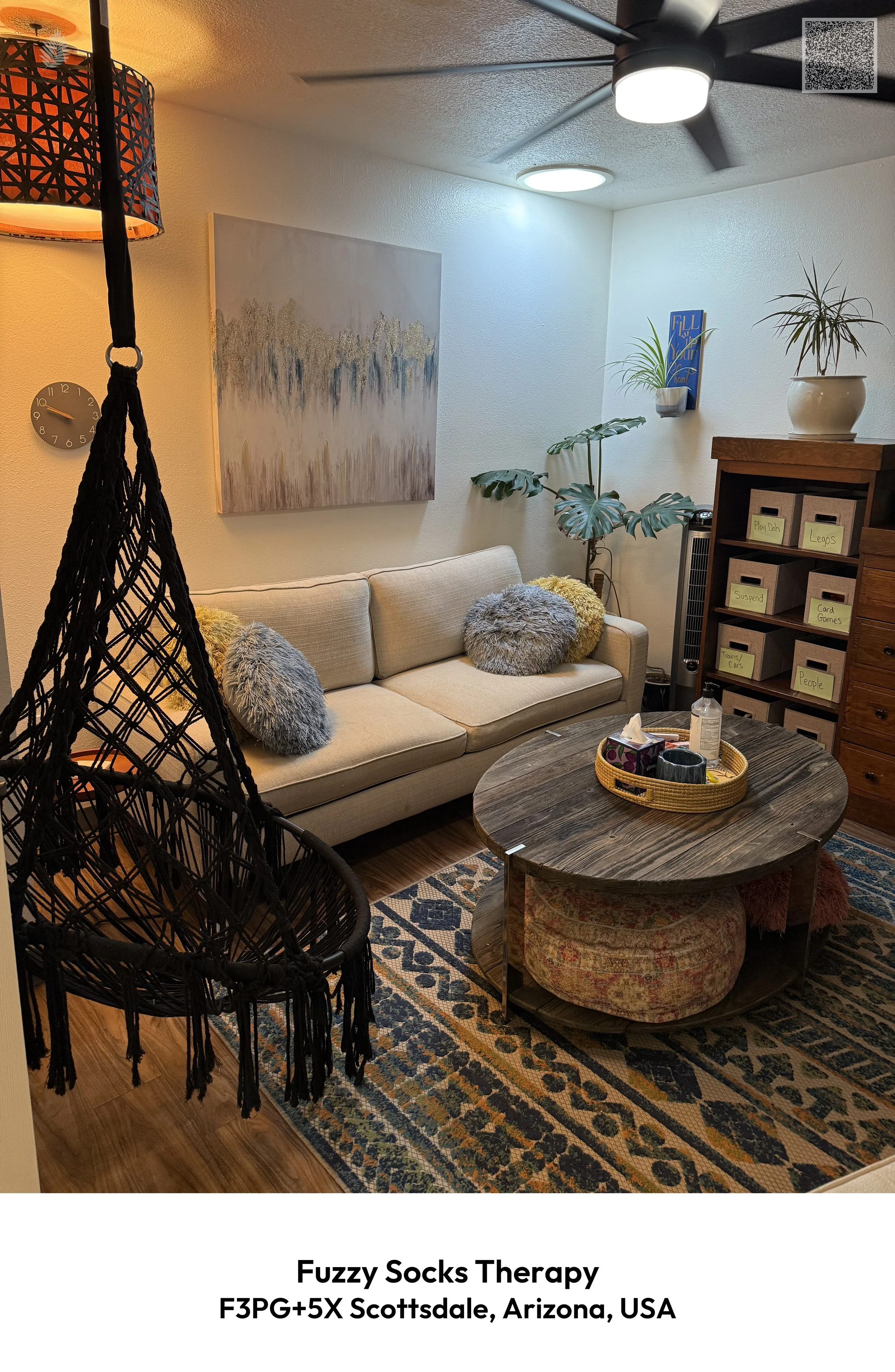
Open-location code (plus code): F3PG+5X Scottsdale, Arizona, USA
Map/listing URL: https://maps.app.goo.gl/cqhwvXU4UMg6QL1YA
Embed iframe:
The practice offers in-person therapy in Scottsdale along with online sessions for clients in Arizona, Colorado, and Florida.
Clients can explore services such as trauma therapy, EMDR therapy, Deep Brain Reorienting Therapy, neurodivergent therapy, child therapy, couples therapy, discernment counseling, and parenting intensives.
Fuzzy Socks Therapy is especially relevant for people navigating trauma, dysfunctional family dynamics, ADHD, autism, relationship conflict, and emotional overwhelm.
The website presents a direct, practical therapy style focused on real tools and meaningful change rather than vague advice.
Scottsdale clients looking for trauma-informed psychotherapy can find support that combines deeper healing work with concrete skill building.
The practice also offers help for adult children of dysfunctional families, couples on the brink, and neurodivergent kids, teens, and adults.
To get started, call (720) 378-8454 or visit https://www.fuzzysockstherapy.com/ to book a free consultation.
A public Google Maps listing is also available for Scottsdale location reference alongside the official website.
Popular Questions About Fuzzy Socks Therapy
What does Fuzzy Socks Therapy help with?
Fuzzy Socks Therapy helps with trauma, dysfunctional family patterns, neurodivergence, relationship conflict, emotional overwhelm, and related challenges for individuals, couples, and families.
Is Fuzzy Socks Therapy located in Scottsdale, AZ?
Yes. The official website lists the office at 3295 N. Drinkwater Blvd., Suite 10, Scottsdale, AZ 85251.
Does Fuzzy Socks Therapy offer in-person and online sessions?
Yes. The official site says the practice offers in-person therapy in Scottsdale and online therapy in Arizona, Colorado, and Florida.
What therapy approaches are listed on the website?
The website highlights EMDR therapy, Deep Brain Reorienting Therapy, discernment counseling, play therapy, Dialectical Behavior Therapy, Emotionally Focused Therapy, and practical trauma-informed skill building.
Who provides therapy at Fuzzy Socks Therapy?
The official website identifies the therapist as Lianna Purjes.
Does the practice offer couples counseling?
Yes. The website includes couples therapy, couples intensives, and discernment counseling for couples deciding whether to stay together or separate.
Does the practice work with children and adolescents?
Yes. The site says the practice offers child therapy and support for children, adolescents, and their families.
How can I contact Fuzzy Socks Therapy?
Phone: (720) 378-8454
Email: [email protected]
Website: https://www.fuzzysockstherapy.com/
Landmarks Near Scottsdale, AZ
Drinkwater Boulevard is the clearest local reference point for this office and helps nearby clients place the practice in Scottsdale. Visit https://www.fuzzysockstherapy.com/ for service details.
Old Town Scottsdale is a familiar city landmark and a practical reference for people searching for therapy near central Scottsdale. Call (720) 378-8454 to learn more.
Scottsdale Civic Center is another recognizable local landmark that helps define the surrounding area for nearby professional services. The official website has current contact details.
Scottsdale Stadium is a well-known destination in the city and a useful point of reference for local users. Fuzzy Socks Therapy offers both in-person and online sessions.
Indian School Road is a major corridor that helps many residents orient themselves in Scottsdale. More information is available at https://www.fuzzysockstherapy.com/.
Fashion Square and the surrounding central Scottsdale area are widely recognized by local residents and visitors alike. Reach out through the website to book a free consultation.
Downtown Scottsdale is a strong local search reference for people seeking counseling and psychotherapy services in the area. The practice serves Scottsdale in person and multiple states online.
Scottsdale Road is another major route that helps define the broader service area for clients traveling from nearby neighborhoods. The practice supports individuals, couples, and families.
The Scottsdale arts and civic district is a useful area reference for those familiar with the city center. Visit the site to review specialties and next steps.
Central Scottsdale commuter corridors make this practice relevant for nearby residents who want in-person therapy, while online sessions add flexibility for clients in Arizona, Colorado, and Florida.